
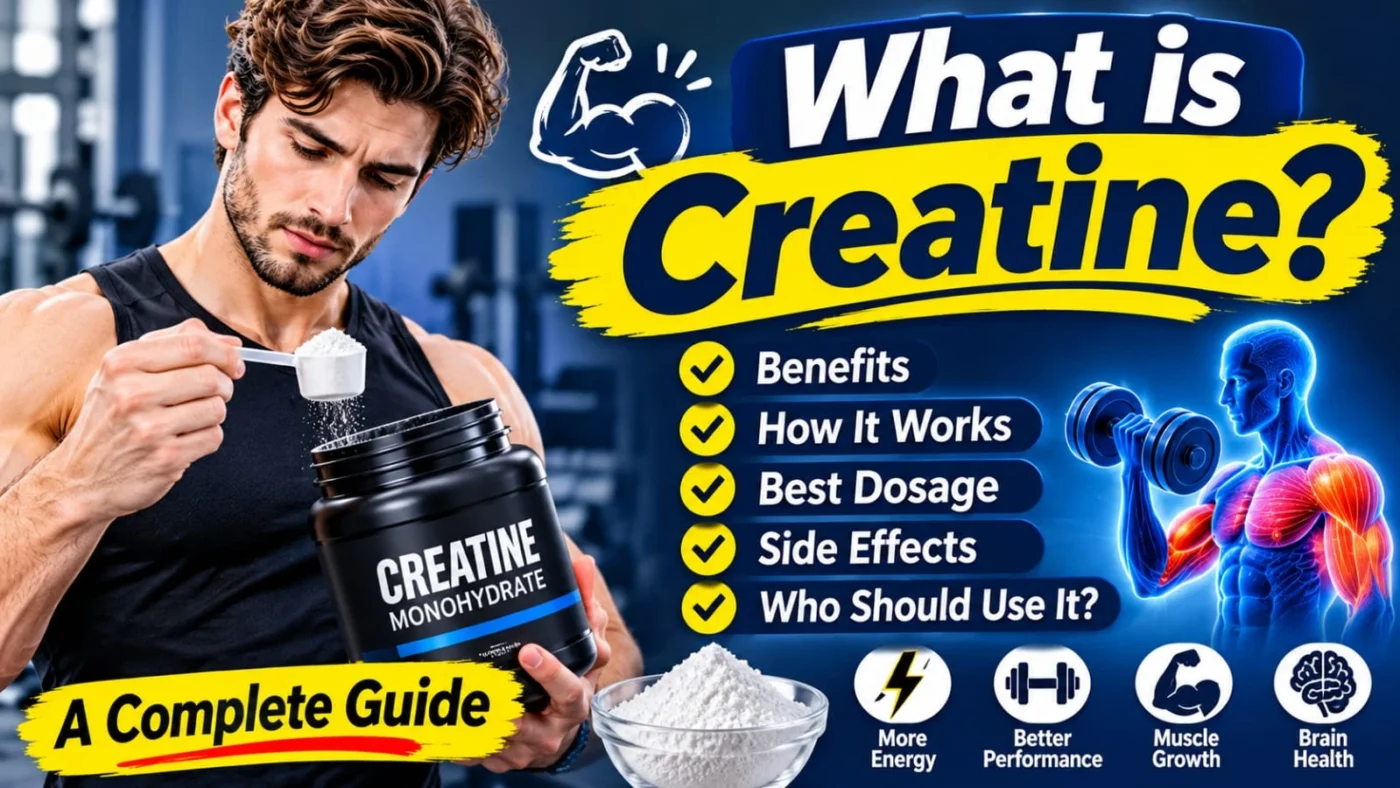
What Is Creatine? How It Works, Benefits, Dose and Safety
Creatine is a compound your body makes from three amino acids and stores mostly in muscle, where it helps recycle ATP, the energy your cells use for short, intense effort. You also get it from meat and fish, and many people take monohydrate supplements to support strength, power and training recovery.
What is creatine?
Creatine is a natural compound built from amino acids that your muscles use as a fast energy reserve. It also exists as a dietary supplement, which is the form most people mean when they ask about it.
The short definition
Your liver, kidneys and pancreas build it from three amino acids: arginine, glycine and methionine. Most of it travels to your skeletal muscles. According to Cleveland Clinic, about 95% of the creatine in your body ends up there, and the rest goes to the heart, brain and other tissues. Inside muscle, much of it is held as phosphocreatine, the form that releases energy quickly during short bursts of activity.
Your body also keeps a steady turnover. Mayo Clinic reports that a typical diet supplies about 1 to 2 grams a day, while the body replaces about 1 to 3 grams a day to maintain its usual stores. If you have been wondering what is creatine doing with those grams, the answer is simple: it keeps a small, fast energy supply topped up.
Where you get it from
Roughly half of your supply comes from food and half from your own body. Animal foods are the dietary source. Plant foods contribute essentially none, which is why your own production matters for people who eat little or no meat.
Table 1: Natural and supplemental sources
| Source | What it provides | Worth knowing |
|---|---|---|
| Red meat (beef, pork, veal) | A major dietary source | Cleveland Clinic names red meat first among protein-rich foods |
| Fish and shellfish | A dietary source | Amounts vary by species, cut and cooking |
| Animal milk (cow, goat, sheep) | A smaller dietary source | Listed by Cleveland Clinic alongside meat and seafood |
| Plant foods | Essentially none | Vegetarians and vegans rely on their own production |
| Your own body | About half of total supply | Made in the liver, kidneys and pancreas |
| Supplements | Pure compound, usually monohydrate powder | Sold as powders, tablets, capsules, liquids and bars |
Published per-serving gram figures for foods disagree widely because cut, species and cooking change the result, so this table sticks to what the medical sources agree on.
How does creatine work in your body?
It works as a rapid energy buffer: muscle cells convert it into phosphocreatine, which hands a phosphate group to spent energy molecules so they can fire again.
Phosphocreatine and ATP
Muscles run on adenosine triphosphate, or ATP. During an all-out effort such as a heavy set or a sprint, your ATP supply drops within seconds. Phosphocreatine rebuilds it almost instantly by donating its phosphate to the depleted molecule. A fuller store in the muscle means a bigger buffer, which is why the benefit shows up mainly in short, repeated, high-intensity work rather than long endurance sessions.
Why muscles and the brain both use it
Muscle holds most of your supply, but the brain stores smaller amounts and uses the same energy system. Cleveland Clinic notes that supplementing can raise phosphocreatine levels in the brain, which may support memory. Mayo Clinic describes the brain research as early and says more studies are needed, so treat cognitive claims as promising rather than proven.
Creatine vs creatinine: what is the difference?
Creatine is the energy compound your muscles use. Creatinine is a waste product that results from muscle activity and protein breakdown, and doctors measure it in blood to judge kidney function.
The names are close enough that people mix them up constantly, and the mix-up matters when a supplement changes a lab result.
Table 2: The two compounds side by side
| Feature | Creatine | Creatinine |
|---|---|---|
| What it is | An energy compound made from amino acids | A waste product |
| Main job | Supplies quick energy to muscle | None; the kidneys filter it out of the blood |
| Where it comes from | Your body, meat and fish, and supplements | Protein digestion and normal muscle breakdown |
| Where you meet it | Supplement labels and sports nutrition | Blood test reports |
| Why it matters | Strength, power and recovery | A marker used to assess kidney function |
| Effect of supplements | Raises muscle stores | Can raise blood levels without kidney damage |
Why supplements can raise creatinine
The National Kidney Foundation lists creatine supplements among the factors that can push blood creatinine higher, along with large amounts of cooked meat, recent intense exercise and a very muscular build. A higher reading in these cases can make kidney function look worse than it is. The National Kidney Foundation also explains that eGFR, the estimate doctors use for kidney function, is more accurate when cystatin C is measured alongside creatinine. If you supplement and have blood work coming up, tell the clinician so they can read the result in context.
Types of creatine
Monohydrate is the form with the strongest research record, and it is the one most products contain.
Several other forms are marketed on the promise of better absorption, smaller doses or fewer stomach problems. The question to ask of each claim is whether anyone has shown it beating plain monohydrate.
Table 3: Common supplement forms
| Form | Evidence base | Common marketing claim | Verdict |
|---|---|---|---|
| Monohydrate | Most studied; reviewed in the ISSN position stand | The standard against which others are judged | Best-supported choice |
| Hydrochloride (HCl) | Limited direct comparisons with monohydrate | Dissolves better, needs a smaller dose | Benefit over monohydrate not established |
| Ethyl ester | Research has not shown it beating monohydrate | Absorbs better | No proven advantage |
| Buffered | Limited | Gentler on the stomach | No proven advantage |
| Liquid | Limited | Convenient, ready to drink | It can break down in solution, so stability is a concern |
Why monohydrate stays the default
Cleveland Clinic states that the benefits for short, high-intensity resistance exercise are tied to monohydrate and that other forms do not appear to match them. It is also usually the cheapest option and has the longest safety record, which makes it the sensible starting point.
What are the benefits of creatine?
The best-supported benefit is greater strength and muscle gain when creatine is combined with resistance training. Findings for the brain and for older adults are encouraging but less settled.
Muscle, strength and performance
Creatine can let an athlete complete more work across repeated short bursts, such as lifting or sprinting. Mayo Clinic says that gains in strength, muscle size and performance are most likely when supplements are paired with resistance training. Cleveland Clinic adds that some studies found people gained an extra two to four pounds of muscle over four to 12 weeks of regular exercise compared with those not supplementing.
Age changes the picture. Cleveland Clinic says the clearest muscle-growth evidence comes from adults aged 18 to 30. Mayo Clinic reports that older adults who combine it with resistance exercise can improve strength. The two statements are about different outcomes, muscle growth in one case and strength in the other, so they do not contradict each other.
Athletes in organized sport can use it too. Cleveland Clinic notes that the International Olympic Committee and the NCAA allow its use as a supplement. Men and women both report benefits, although some studies suggest women may gain less strength and muscle mass than men.
Brain and memory
A systematic review of randomized trials, Avgerinos and colleagues, examined its effect on cognitive function in healthy people, and a 2022 review of brain function and health covers the wider research. Mayo Clinic summarizes this area as early evidence of better memory and thinking skills, especially in older adults, with more work still needed.
Older adults and other conditions
Mayo Clinic finds no clear benefit for total bone mineral density and says evidence for heart failure is limited. In children with certain rare creatine deficiency syndromes, supplements might improve some symptoms, but that is a medical use that belongs under a specialist’s care.
How much creatine should you take?
Most healthy adults follow the guidance in the ISSN position stand: 3 to 5 grams of monohydrate daily, with an optional loading phase of about 20 grams a day for five to seven days. This is general information, not medical advice.
Table 4: Common dosing approaches
| Approach | Daily amount | Duration | Who it suits |
|---|---|---|---|
| Maintenance only | 3 to 5 g | Daily, ongoing | People happy to wait longer for muscle stores to fill |
| Loading, then maintenance | About 20 g split into four doses of about 5 g, then 3 to 5 g | 5 to 7 days of loading, then daily | People who want stores filled faster and tolerate larger doses |
| Rest days | Same maintenance dose | Every day, training or not | Anyone already supplementing |
Loading versus no loading
Loading fills muscle stores in about a week. Skipping it reaches the same level more slowly, over several weeks. Neither route is wrong, and the long-term level is what matters. Large loading doses are the point where stomach upset becomes more likely, which is a reason many people skip the phase.
Timing and rest days
Evidence that the time of day changes results is limited, and any difference appears small. Consistency matters more. Because it works by keeping stores full, taking it on rest days as well keeps them full. If a dose upsets your stomach, Cleveland Clinic advises splitting your daily amount into smaller portions across the day.
How to start, step by step
- Check with a healthcare provider first if you are pregnant, breastfeeding, or have diabetes, kidney disease, liver disease or bipolar disorder.
- Choose plain monohydrate from a brand that publishes third-party testing.
- Decide between a loading week and a steady 3 to 5 grams from day one.
- Take it every day, mixed into a drink or food, at a time you will remember.
- Pair it with resistance training and judge results after several weeks, not several days.
- Stop and speak to a clinician if side effects persist.
If you stop, your levels fall gradually over the next few weeks. Cleveland Clinic says you can keep much of the strength you built through regular exercise, but you should not expect continued improvement.
Creatine side effects and safety
At recommended doses, creatine is likely safe for many people for up to five years, according to Mayo Clinic, and weight gain is its best-documented side effect.
Kidneys
Some older reports suggested it could worsen kidney function in people who already have kidney conditions. Mayo Clinic says studies in healthy people taking recommended doses have not found kidney harm, and that research in people with kidney disease is limited, so those people should talk with their care team first. Remember that supplementing can raise the creatinine number on a blood test without meaning the kidneys are failing.
Bloating and weight gain
Cleveland Clinic lists weight gain from water retention as the common effect, with dizziness, nausea and vomiting, diarrhea and excessive sweating also possible. Muscles hold more water when stores rise, so a small jump on the scale in the first week is expected and is not fat.
Cramps and dehydration
Mayo Clinic states that research does not show a higher risk of muscle cramps or muscle injury in people taking it. Cleveland Clinic goes further and says it may reduce cramping and dehydration. The safe reading is that no source reviewed here supports the idea that it causes cramps, while the claim that it prevents them is less certain.
Hair loss and hormone claims
The hair loss rumor traces to a small 2009 study in rugby players that found a rise in dihydrotestosterone, a hormone linked to male pattern hair loss. That study did not measure hair loss, and the medical sources reviewed for this article do not list hair loss as a side effect. Treat it as unproven. The same caution applies to claims that it boosts testosterone and other hormones, which are less well supported than its strength benefits.
Who should check first, and what it interacts with
People who are pregnant or breastfeeding, or who have diabetes, kidney disease or liver disease, should speak with a clinician first, because Cleveland Clinic says there is not enough evidence to confirm safety in those groups. It also warns that it may raise the risk of mania in people with bipolar disorder.
Caffeine and other interactions
Mayo Clinic says caffeine might reduce how well the supplement works, though more research is needed. In one large study of people with Parkinson’s disease who took it, those consuming more than 300 milligrams of caffeine daily saw faster disease progression, as reported in a 2015 study in Clinical Neuropharmacology. If you take any prescription medicine, ask a pharmacist about interactions before adding a supplement.
How to choose a creatine supplement
Choose plain monohydrate from a company that publishes independent test results. In the United States, supplements are not pre-approved the way prescription medicines are, so the label deserves more scrutiny.
Use this checklist when comparing products:
- One ingredient: monohydrate, with no proprietary blend hiding the amount.
- A clear serving size that matches the 3 to 5 gram range.
- Independent testing evidence rather than only the brand’s own claims.
- No promises of faster absorption, no loading needed, or multiples of effectiveness.
- A recognizable manufacturer with contact details and batch information.
What third-party seals mean
Programs such as NSF Certified for Sport and Informed Sport test products for label accuracy and banned substances. Mayo Clinic recommends picking products made under good manufacturing practices with third-party testing. For wider background on food and supplements, browse the Nutrition section, the Fitness section, or the main Health & Wellness hub on Gotpedia.
Frequently Asked Questions
What does creatine do to your body?
Creatine helps muscle cells recycle ATP, the molecule that powers short, intense effort. With regular supplementation and resistance training, that can mean more strength, more repetitions and slightly faster recovery. Muscles also hold more water, so you may see a small early weight gain.
Is creatine safe to take every day?
For most healthy adults, yes. Mayo Clinic says it is likely safe at recommended doses for up to five years. Daily use is how supplementation works, since it keeps muscle stores full. Anyone with kidney or liver disease, diabetes, pregnancy or bipolar disorder should check with a clinician first.
How much creatine should I take a day?
The ISSN position stand supports 3 to 5 grams of creatine monohydrate daily for most adults. Some people load first with about 20 grams a day for five to seven days, but loading is optional. Your own needs can differ, so confirm with a healthcare provider if you have a health condition.
Do I need a loading phase?
No. Loading fills muscle stores in about a week, while a steady 3 to 5 grams reaches the same level over several weeks. Choose loading if you want faster results and tolerate larger doses. Skip it if large amounts upset your stomach.
Does creatine damage the kidneys?
Studies in healthy people at recommended doses have not found kidney harm, according to Mayo Clinic. Research in people who already have kidney disease is limited, so they should talk to their care team first. It can also raise blood creatinine, which may be misread as reduced kidney function.
Does creatine cause hair loss?
This is unproven. The rumor comes from a small 2009 study that found higher dihydrotestosterone in rugby players, but it did not measure hair loss. The medical sources reviewed here do not list hair loss as a side effect. If you are prone to hair loss, you can discuss it with a doctor.
Is creatine a steroid?
No. Creatine is a compound built from amino acids that your body makes naturally and that you also get from meat and fish. Anabolic steroids are synthetic versions of sex hormones. It works by supplying muscle energy, not by acting as a hormone.
What is the difference between creatine and creatinine?
Creatine is the energy compound your muscles use. Creatinine is a waste product formed from protein digestion and normal muscle breakdown, and it appears on kidney blood tests. Taking supplements can raise creatinine readings, so mention your supplement before any lab work.
Which type of creatine is best?
Creatine monohydrate is the best-supported choice. It has the most research behind it and is usually the cheapest. Forms such as HCl, ethyl ester and buffered versions are marketed for better absorption, but they have not been shown to outperform plain monohydrate.
Can women take creatine?
Yes. Cleveland Clinic notes that both men and women report benefits. Some studies suggest women may gain somewhat less strength and muscle mass than men. The standard 3 to 5 gram daily approach applies, and women who are pregnant or breastfeeding should check with a healthcare provider first.
Should I take creatine on rest days?
Yes, most guidance recommends continuing the maintenance dose on rest days. It works by keeping muscle stores full, so skipping days slowly lets them drop. Timing during the day matters little, and taking it with food can help if it upsets your stomach.
Who should not take creatine?
Check with a clinician first if you are pregnant or breastfeeding, or have diabetes, kidney disease or liver disease, because safety evidence in these groups is limited. People with bipolar disorder may face a higher risk of mania, according to Cleveland Clinic. Anyone on prescription medication should ask a pharmacist about interactions.
Sources and Methodology
External sources cited in this article:
- Cleveland Clinic, Creatine: https://my.clevelandclinic.org/health/treatments/17674-creatine
- Mayo Clinic, Creatine: https://www.mayoclinic.org/drugs-supplements-creatine/art-20347591
- National Kidney Foundation, Creatinine: https://www.kidney.org/kidney-topics/creatinine
- Kreider RB et al., International Society of Sports Nutrition Position Stand: Safety and Efficacy of Creatine Supplementation in Exercise, Sport, and Medicine: https://jissn.biomedcentral.com/articles/10.1186/s12970-017-0173-z
- Avgerinos KI et al., Effects of Creatine Supplementation on Cognitive Function of Healthy Individuals: https://www.ncbi.nlm.nih.gov/pmc/articles/PMC6093191/
- Forbes SC et al., Effects of Creatine Supplementation on Brain Function and Health, Nutrients, 2022: https://doi.org/10.3390/nu14050921
- Simon DK et al., Caffeine and Progression of Parkinson’s Disease: A Deleterious Interaction with Creatine, Clinical Neuropharmacology, 2015: https://doi.org/10.1097/WNF.0000000000000102
The Gotpedia Editorial Team compared the pages above with the primary studies they cite, and wrote this guide from those sources rather than from competing articles. Where the sources disagree, as with cramps, we say so. We avoided specific numbers we could not trace to a source. This article is general information and not medical advice; see how we work on the About page.