
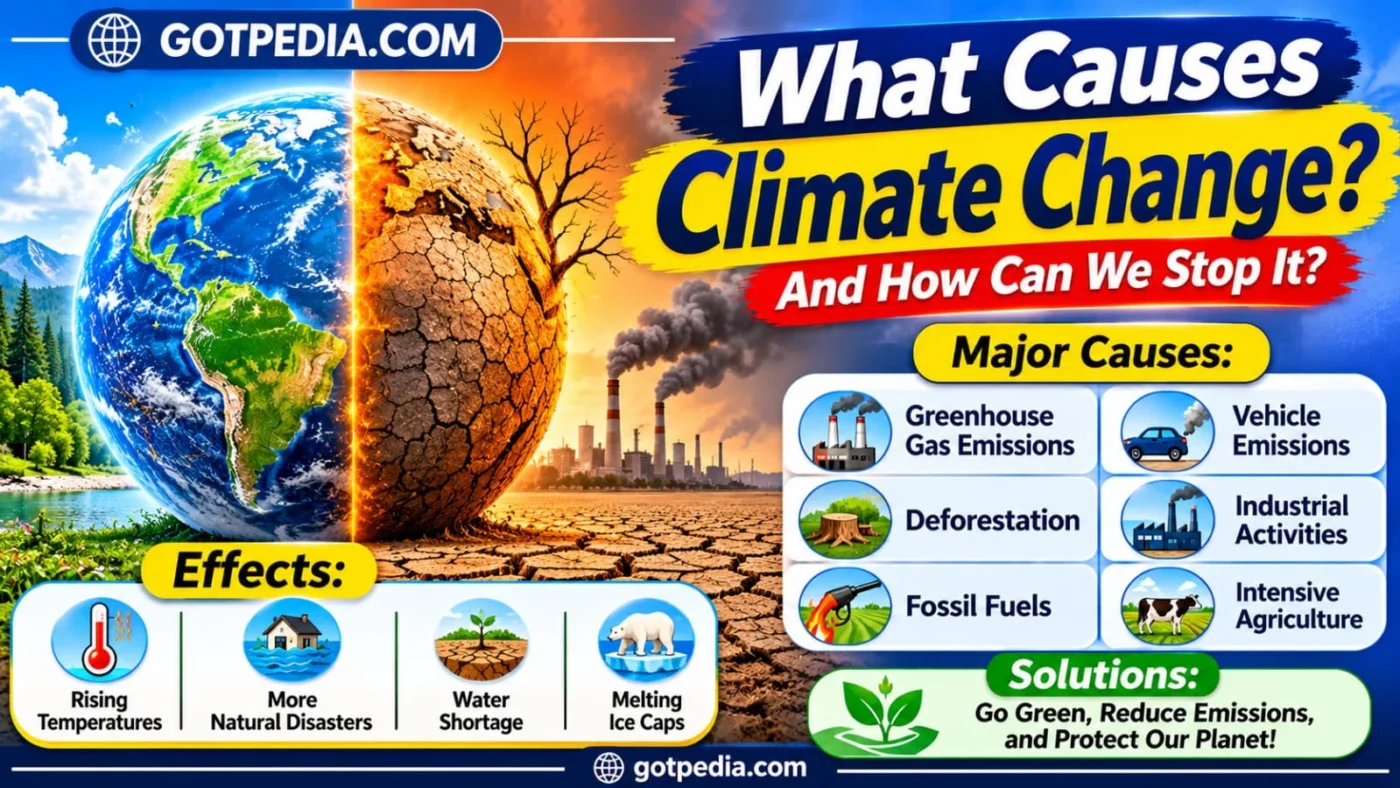
What Causes Climate Change? Natural vs Human Causes, Explained
Climate change today is mainly caused by human activity. Burning coal, oil and gas releases carbon dioxide, and farming, deforestation and industry add methane, nitrous oxide and other gases. These greenhouse gases trap heat in the atmosphere. Natural factors like the Sun and volcanoes cause past shifts but cannot explain current warming.
So what causes climate change, and how much of it is natural? This guide separates the two, shows the numbers by gas and by sector, explains how scientists tell them apart, and clears up the myths that muddy the picture. Readers who want wider context can browse the Nature & Environment articles on Gotpedia alongside this guide.
How the Greenhouse Effect Works
The greenhouse effect is the natural process by which gases in the atmosphere absorb heat rising from Earth’s surface and send part of it back down. It keeps the planet livable, and climate change begins when human activity makes that heat-trapping layer thicker.
Sunlight passes through the atmosphere and warms the ground and oceans. The surface then gives that energy off as infrared heat. Greenhouse gases absorb a large share of it and re-radiate it in every direction, so heat escapes to space more slowly than it otherwise would. Add more of those gases and the planet holds on to more heat.
The numbers show how far the balance has moved. According to NASA’s causes page, industrial activity has raised atmospheric carbon dioxide by nearly 50% since 1750. The European Commission’s climate service reports that 2015–2024 was the warmest decade on record, that 2024 reached 1.55°C above pre-industrial levels, and that human-induced warming is rising by 0.25°C per decade. A single year above 1.5°C is not the same as crossing the Paris Agreement’s long-term goal, which is judged over decades, but the direction is clear.
Greenhouse Gases Compared
Carbon dioxide is the largest single contributor to human-caused warming, but methane, nitrous oxide, fluorinated gases and CFCs add their own share, each with a different lifetime and strength.
| Gas | Main human sources | What to know |
|---|---|---|
| Carbon dioxide (CO2) | Burning coal, oil and gas; deforestation | Largest contributor to human-caused warming; 51% above its pre-industrial level by 2023 |
| Methane | Livestock, landfills, rice farming, fossil fuel leaks | More powerful than CO2 but breaks down faster |
| Nitrous oxide | Fertilisers, burning fuels and vegetation | Up 18% over the last 100 years; accumulates for decades |
| Fluorinated gases | Equipment and products that use them | Up to 23,000 times as strong as CO2 |
| CFCs | Refrigerants, solvents, spray propellants | Do not exist in nature; entirely industrial |
| Water vapor | Rises as the air warms | Most abundant greenhouse gas, but a feedback rather than a direct cause |
Figures in Table 1 come from the NASA and European Commission pages cited above. To compare gases fairly, scientists use global warming potential, which converts each gas into a carbon dioxide equivalent (CO2e) over a chosen period, most often 100 years. That is why a small leak of methane or a fluorinated gas can matter more than its tonnage suggests.
Water vapor deserves a note. It is the most abundant greenhouse gas, yet it does not start the warming. Warmer air holds more of it, which amplifies the warming that other gases began, a process scientists call a feedback.
What Causes Climate Change? The Human Activities Behind Rising Emissions
Most human-caused warming traces back to burning fossil fuels for energy, with farming and land clearing adding methane, nitrous oxide and lost carbon storage. The United Nations puts fossil fuels at nearly 90 per cent of all carbon dioxide emissions.
Burning Fossil Fuels for Electricity and Heat
Power stations and home furnaces that burn coal, oil or gas release carbon dioxide and nitrous oxide. Wind, solar and other renewables emit little to none, which is why the mix of a country’s electricity matters so much to its total.
Transport
Cars, trucks, ships and planes mostly run on petroleum products. Road vehicles produce the largest share, and transport as a whole accounts for nearly one quarter of global energy-related carbon dioxide emissions.
Industry and Manufacturing
Factories burn fuel to make cement, steel, plastics, electronics and clothing, and some processes release gases through chemical reactions even when no fuel is burned. Plastics are also made from fossil-fuel chemicals, so their production carries a built-in carbon cost.
Agriculture and Livestock
Cows and sheep release methane as they digest food, flooded rice fields and manure add more, and nitrogen fertilisers produce nitrous oxide. Fuel for tractors, irrigation pumps and fishing boats adds carbon dioxide on top.
Deforestation and Land Use
Trees lock carbon away as they grow and release it when they are cut or burned. Clearing land also removes a natural absorber of carbon dioxide. The UN reports roughly 10 million hectares of forest are destroyed each year.
Buildings
Homes and offices consume nearly 60 per cent of the world’s electricity, according to UN figures, and many still rely on gas, oil or coal for heating. Rising air-conditioner ownership is pushing demand higher.
Waste and Landfills
Rotting food and other organic waste in landfills release methane. Burning waste adds carbon dioxide, and the fossil-fuel origin of plastics means disposal is part of the same story.
Where Emissions Come From: The US Sector View
In the United States, transportation is the largest source of greenhouse gas emissions, followed by electricity production and industry. The latest sector split published from the EPA’s greenhouse gas inventory describes 2022.
| Sector | Share of US emissions | Where it comes from |
|---|---|---|
| Transportation | 28.4% | Cars, trucks, trains, ships and aircraft burning petroleum fuels |
| Electricity production | 24.9% | Generating, transmitting and distributing power |
| Industry | 22.9% | Making goods and raw materials, including process chemistry |
| Agriculture | 10.0% | Crop and livestock production |
The rest comes mainly from homes, commercial buildings and smaller sources. USAFacts reports that the country emitted 6.3 billion metric tons of CO2 equivalent that year. One caution when reading sector charts: if electricity emissions are reassigned to the homes, offices and factories that use the power, those sectors’ shares rise and the ranking shifts.
The global picture is more uneven than the sector split suggests. The UN notes that the 20 largest economies account for almost 80 per cent of global emissions, so responsibility is concentrated rather than evenly spread.
Natural Causes of Climate Change
Natural causes include changes in the Sun’s output, volcanic eruptions, slow shifts in Earth’s orbit and the drift of continents. All are real, and Britannica’s climate overview explains how they shaped past climates, but none matches the speed of warming seen since the mid-20th century.
Changes in the Sun
The Sun’s energy output follows a cycle of about 11 years and varies over longer periods. A drop in solar activity, together with heavy volcanic activity, helped trigger the Little Ice Age, and the Maunder minimum between 1645 and 1715 has been suggested as a contributing factor. Those are real natural effects, but the Sun has shown no net increase in output over the period when temperatures climbed.
Volcanic Eruptions
Large eruptions throw sulfur dioxide into the stratosphere, where it forms particles that reflect sunlight and cool the surface for a year or two. Mount Tambora’s 1815 eruption led to 1816, known as the year without a summer. Volcanoes also release carbon dioxide, but even an eruption as large as Mount Pinatubo in 1991 emits only a fraction of what fossil-fuel burning releases in a single year.
Orbital Cycles and Continental Drift
Earth’s orbit stretches and tilts in predictable cycles. The shape of the orbit changes over 100,000 and 413,000 years, the tilt of the axis swings between 22.1° and 24.5° every 41,000 years, and the wobble of the axis repeats about every 26,000 years. These Milankovitch cycles pace the ice ages. Moving continents and rising mountain ranges alter climate over millions of years. Every one of these is far too slow to explain change within a human lifetime.
Ocean and Atmospheric Cycles
Patterns such as El Niño move heat between the ocean and the air, which makes some years warmer or cooler than the trend. They reshuffle existing heat rather than adding new heat to the system, so they cannot produce a steady, decades-long rise.
Natural vs Human Causes Side by Side
Natural factors changed the climate for most of Earth’s history, but the recent warming does not fit their timing or size. The European Commission estimates that solar and volcanic changes contributed less than plus or minus 0.1°C to total warming between 1850 and 2019.
| Cause | Type | How it acts | Timescale | Explains recent warming? |
|---|---|---|---|---|
| Solar output | Natural | Changes the energy reaching Earth | 11-year cycle and longer | No: no net rise in output over the warming period |
| Volcanic eruptions | Natural | Sulfur particles cool the surface; CO2 release is small | One to two years for cooling | No |
| Orbital cycles | Natural | Shift how sunlight is spread across seasons and latitudes | 26,000 to 413,000 years | No |
| Ocean cycles | Natural | Move heat between ocean and air | Years to decades | No: they redistribute heat |
| Fossil fuels and land use | Human | Raise greenhouse gas concentrations | Decades | Yes |
| Agriculture | Human | Adds methane and nitrous oxide | Decades | Yes, as a contributor |
How Scientists Know Humans Are the Cause
Scientists are confident because several independent lines of evidence point to human activity, and none points elsewhere. The Intergovernmental Panel on Climate Change concluded in its Sixth Assessment Report that it is unequivocal that human activities caused the rise of carbon dioxide, methane and nitrous oxide in the atmosphere during the industrial era.
The Isotope Fingerprint
Carbon from burned fossil fuels carries a distinct isotopic signature, and researchers can measure it in the air. NOAA’s isotope explainer describes how that fingerprint ties the rise in atmospheric carbon dioxide to human sources. The figure of nearly 50% growth since 1750 comes from the Global Carbon Budget 2022, an annual accounting of carbon sources and sinks.
| Evidence | What scientists observe | Why it points to humans |
|---|---|---|
| Carbon isotopes | Atmospheric carbon carries a fossil-fuel signature | Natural sources do not leave that pattern |
| Layers of the atmosphere | Cooling in the upper atmosphere, warming at the surface and lower layers | A brighter Sun would warm every layer; greenhouse gases trap heat low down |
| Solar record | No net increase in solar energy reaching Earth since 1880 | The Sun cannot account for the temperature rise |
| Climate models | Models reproduce observed warming only when greenhouse gases are included | Natural factors alone leave the trend unexplained |
Gotpedia’s Science & Technology section collects related explainers on how research like this is done.
Common Myths About the Causes of Climate Change
Most confusion comes from a handful of repeated claims, and each one fails on timing, size or basic physics.
The ozone hole is not the cause. It is a separate problem, although the chemicals that damaged the ozone layer are also greenhouse gases, so the European Union’s causes explainer notes that restricting them has helped the climate as well.
Water vapor is not the main cause. It responds to warming rather than starting it.
Volcanoes do not emit more carbon dioxide than humans. Even a giant eruption releases only a fraction of annual fossil-fuel emissions.
A cold winter does not disprove warming. Weather is what happens on a given day, while climate is the long-term average, so one cold spell says little about the trend.
It is not just natural cycles. Natural cycles are real, but the timescales and sizes in Table 3 do not match the observed change.
A five-step check for any claim about the causes:
- Identify which cause the claim names: the Sun, volcanoes, ocean cycles or human activity.
- Check the timescale. Does that cause act over years, or over tens of thousands of years?
- Compare the size. Is the effect big enough to match the observed warming?
- Find the original report or dataset, such as the IPCC, a space agency or a national inventory.
- Look at the data year, because emission inventories lag and older shares may have changed.
Frequently Asked Questions
What are the main causes of climate change?
The main causes are burning fossil fuels, deforestation, livestock and fertiliser use, industrial processes and waste. Together they release carbon dioxide, methane, nitrous oxide and fluorinated gases that trap heat in the atmosphere. Fossil fuel combustion is the largest contributor, accounting for nearly 90 per cent of carbon dioxide emissions according to the United Nations.
Is climate change caused by humans or nature?
Both play a role, but humans drive today’s warming. Natural factors such as solar changes, volcanoes and orbital cycles shaped past climates, yet the European Commission estimates they contributed less than plus or minus 0.1°C between 1850 and 2019. The IPCC calls human influence on the rise in greenhouse gases unequivocal.
What is the biggest cause of climate change?
Burning fossil fuels is the biggest cause. Coal, oil and gas combustion for electricity, heat, transport and industry releases most of the carbon dioxide that human activity adds to the air. In the United States, transportation was the largest sector in 2022 at 28.4% of emissions, ahead of electricity production at 24.9%.
How do we know humans are causing it?
Scientists use several independent checks. Carbon from fossil fuels has a distinct isotopic fingerprint in the air, the upper atmosphere is cooling while the surface warms, solar output shows no net rise, and climate models match observed temperatures only when greenhouse gases are included. All of these point to human activity.
Is the Sun causing global warming?
No. Measurements show the Sun’s energy reaching Earth followed its 11-year cycle with no net increase since 1880, while global temperature rose markedly. If a stronger Sun were responsible, every layer of the atmosphere would warm, yet the upper atmosphere is cooling. Solar changes did influence past climates, including the Little Ice Age.
Do volcanoes cause climate change?
Volcanoes affect climate, but mostly by cooling it for a year or two. Eruptions inject sulfur particles that reflect sunlight, as after Mount Tambora in 1815. They also emit carbon dioxide, yet a major eruption like Pinatubo releases only a fraction of what fossil fuel burning emits annually, so volcanoes cannot explain recent warming.
Which gas causes the most warming?
Carbon dioxide causes the most human-driven warming because it is emitted in huge quantities and stays in the atmosphere for a long time. Other gases are stronger per unit: methane is more powerful but shorter-lived, and some fluorinated gases are up to 23,000 times as strong. Water vapor is the most abundant but acts as a feedback.
Does livestock farming cause climate change?
Yes, livestock farming contributes. Cows and sheep release methane when they digest food, manure adds more, and growing feed crops brings fertiliser-related nitrous oxide and land clearing. Methane is more powerful than carbon dioxide but breaks down faster, so cutting it can slow warming in the short term, while carbon dioxide must reach net zero to stop it.
Is water vapor a cause?
Water vapor is the most abundant greenhouse gas, but it is not a direct cause of climate change. Its amount in the air rises as the planet warms, which amplifies warming started by carbon dioxide and other gases. Scientists describe this as a feedback, because water vapor responds to temperature rather than setting it.
Is global warming the same as climate change?
No. Global warming refers to the rise in Earth’s average surface temperature, while climate change covers the wider set of effects that warming triggers, including shifting rainfall, stronger storms, melting ice and rising seas. Global warming is one feature of climate change, which is why both terms appear in discussions of the same causes.
Sources and Methodology
- https://science.nasa.gov/climate-change/causes/
- https://climate.ec.europa.eu/climate-change-explained/causes-climate-change_en
- https://climate.ec.europa.eu/our-planet-our-future/causes_cs
- https://www.un.org/en/climatechange/science/causes-effects-climate-change
- https://www.britannica.com/science/climate-change
- https://www.ipcc.ch/report/ar6/wg1/
- https://gml.noaa.gov/ccgg/isotopes/chemistry.html
- https://doi.org/10.5194/essd-14-4811-2022
- https://usafacts.org/articles/what-are-the-main-sources-of-us-greenhouse-gas-emissions/
- https://www.epa.gov/ghgemissions/inventory-US-greenhouse-gas-emissions-and-sinks
We read each source page directly and took every figure from the page that states it. US sector shares come from the EPA greenhouse gas inventory as reported by USAFacts for 2022, and later inventories will replace them. Orbital cycle lengths, volcanic events and the history of solar variation come from Britannica. Anything we could not trace to a source was left out. Use the Explore page to find related Gotpedia guides.